
Why not just put your call transcripts into Claude or ChatGPT?
Asking AI to work through raw sales call transcripts every time is inefficient at scale. Here’s why preprocessing conversations into reusable insights gives better, more focused answers.
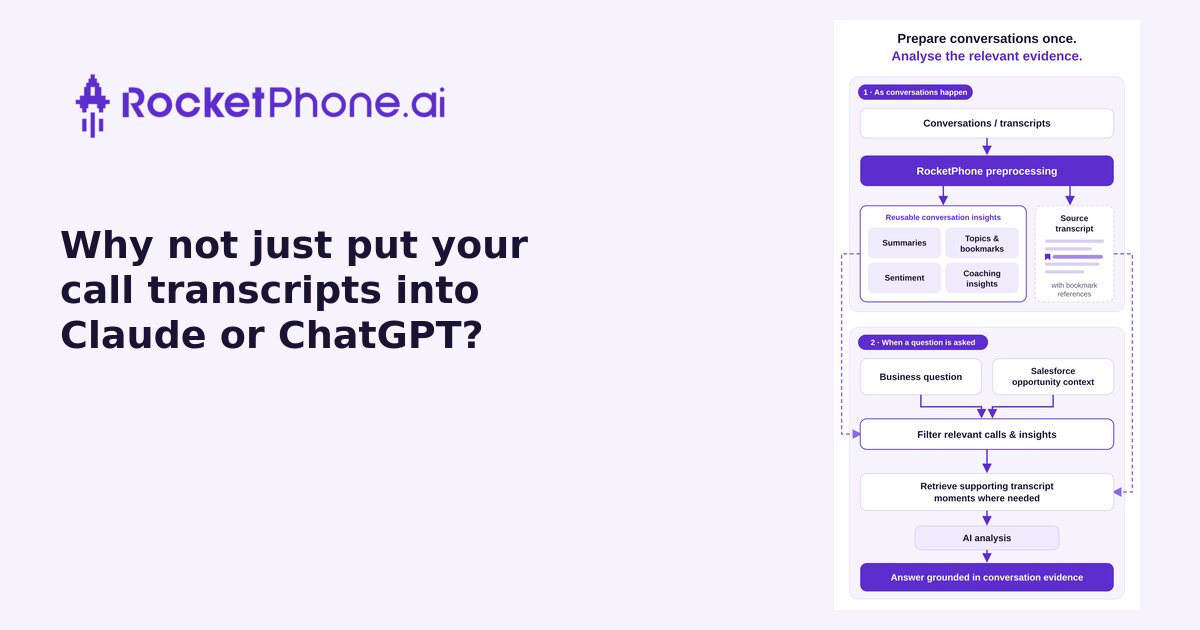
If you already record and transcribe your sales calls, the next step seems obvious: give the transcripts to Claude or ChatGPT and start asking questions.
Which deals are likely to close? Why are we losing opportunities? What objections keep coming up?
It sounds straightforward. The conversations contain the evidence, and AI can analyse text. Why would you need anything else?
For a handful of calls, that can be useful. Across an entire sales organisation, repeatedly asking AI to work through raw transcripts becomes an inefficient way to get answers.
That is where conversation preprocessing earns its place.
One call is manageable. A quarter’s worth is a different job.
Imagine a team of 100 salespeople, each having five conversations a day. Over 60 working days, that adds up to 30,000 conversations.
Now ask:
“Which of our open opportunities show signs that the customer won’t be ready to buy this quarter?”
The evidence could be scattered across months of discussions: a delayed project, an unresolved objection, a missing decision-maker or a budget that has never been approved.
Sending every transcript to an AI model means asking it to sift through introductions, routine updates, repeated information and unrelated conversations to find those moments.
There are limits to how much text a model can consider in a single request. Larger collections need filtering, retrieval or processing in batches. That work has to happen somewhere and repeatedly analysing large amounts of text adds processing time and cost.
To be clear, tools like Claude and ChatGPT can use retrieval to search files rather than reading everything at once; the problem is repeatedly working from raw transcripts each time a question is asked, rather than building on information already prepared.
The question is how much of that work you leave until someone wants an answer.
RocketPhone does valuable work before the question is asked
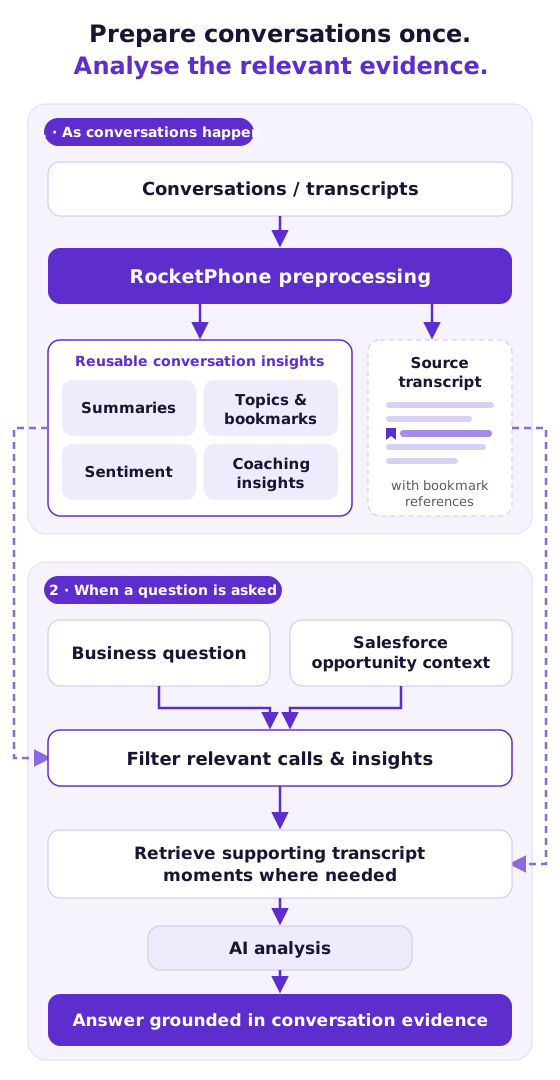
RocketPhone processes conversations into summaries, topics, sentiment, coaching insights and bookmarks that identify important moments.
That processing creates reusable information from each call. A conversation becomes easier to search, assess and revisit, without starting from the full transcript every time.
Each element serves a purpose:
- Summaries provide an overview of what happened.
- Topics and bookmarks help identify relevant discussions and locate specific moments.
- Sentiment and coaching insights add signals that can inform further investigation.
The transcript remains the detailed source. The preprocessing gives subsequent analysis a more focused starting point.
Why bookmarks still matter when you have a summary
A summary compresses a conversation. Inevitably, some detail gets left out.
“Customer discussed pricing and next steps” might be an accurate summary. But there is a substantial difference between:
“We have the budget and need to start this month.”
And:
“We like it, but the budget won’t be available until next year.”
Both conversations could receive a similar high-level description. The underlying statements have very different implications for the opportunity.
Bookmarks help preserve a route back to those important moments. They make it easier to examine the evidence behind an insight, including the surrounding discussion.
That matters when a sales leader needs to understand why a deal looks healthy—or why it deserves closer attention.
Filter first, then examine the evidence
Consider the question about opportunities that might slip beyond the quarter.
An efficient analysis would start by identifying the relevant open opportunities in Salesforce. It could then examine associated conversation insights, locate discussions about timing, budget and decisions, and retrieve transcript detail where needed.
This is the value of preparing conversation data for analysis: less irrelevant material to process, with a route back to the detail that matters.
The same principle supports questions about recurring objections, differences between won and lost deals, or areas where a team needs coaching.
Some questions still require broad analysis across many calls. Preprocessing does not eliminate that work. It provides reusable inputs so every question does not have to begin with thousands of raw transcripts.
The value goes beyond transcription
A transcript captures what was said. Making that information useful across a sales organisation requires further work: identifying important moments, organising the evidence and connecting it with CRM activity and outcomes.
Claude and GPT can play a valuable role in that analysis. The quality and efficiency of the workflow depend on the information they receive.
That is why RocketPhone’s conversation processing matters. It prepares the evidence continuously, helping teams get more value from their conversations when it is time to ask a business question.
Want to see how RocketPhone prepares your conversations for analysis? Book a demo and we’ll walk you through it.